
Oh, Henry
E&G | Issue 302
Published without edits😊
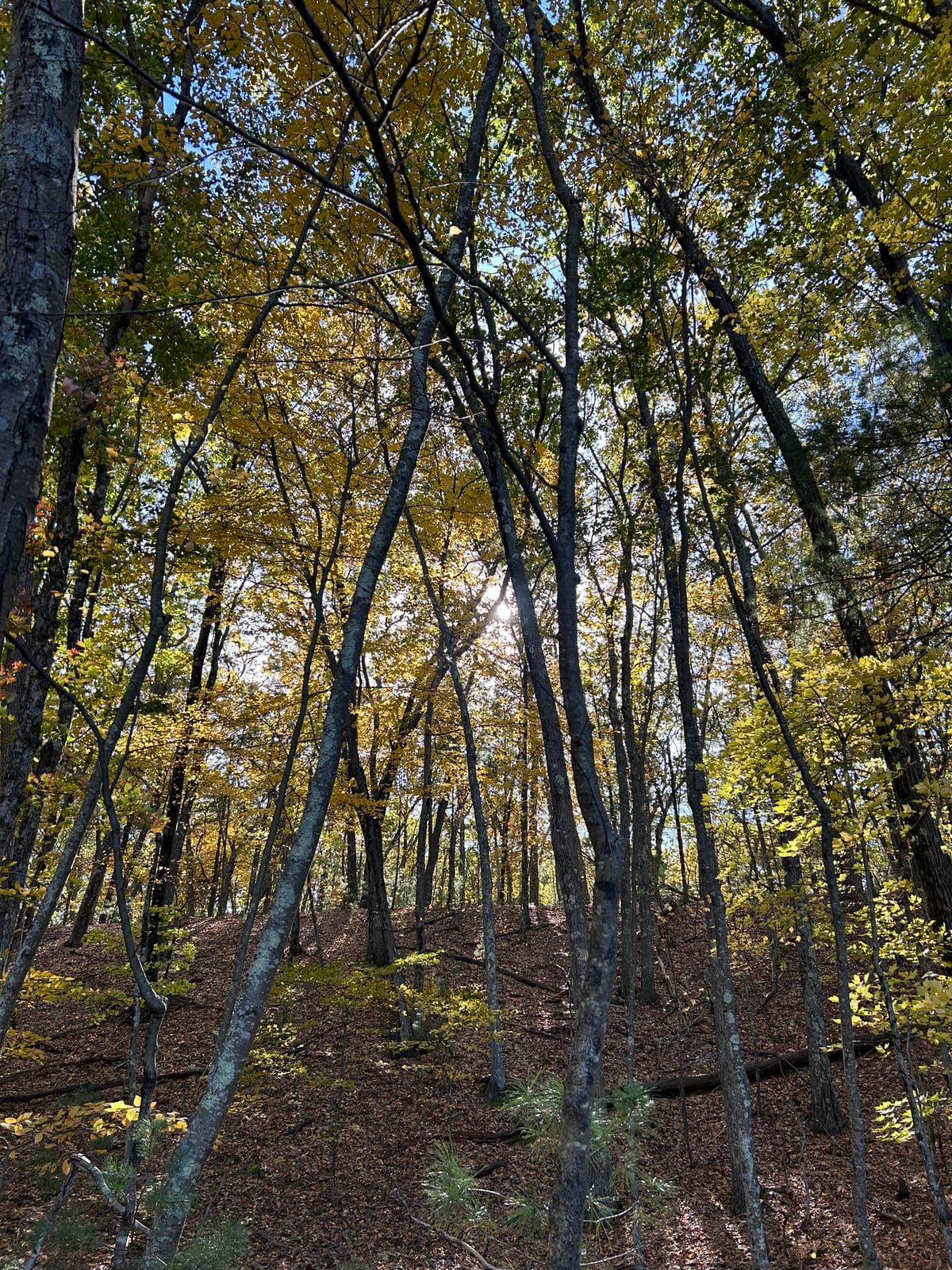
A yellow beech leaf floated carelessly down from the canopy of trees around Walden Pond. 34 minutes prior, we had inserted a credit card to pay for our parking to visit these sacred grounds and I joked that Thoreau must be rolling over in his grave. There’s a gift shop there, I know where he would have stood on that. I cursed the shoes that I chose to wear that day, I wondered if he walked those paths barefoot and swam naked. Of course he did; he was not a man encumbered by the expectations of others. Yesterday was the yellowest of days, the yellowest I can remember in recent history. Yellow days are good days, days on which the sun feels warm, the air cool, and your mind allows the passage of time.
I had no desire to go to a protest this weekend. I went to a protest in Venezuela once and that cured me of ever desiring to exercise my first amendment rights in that way. Something about tear gas and gunfire makes you question whether or not your ideals are worth dying for. Young and full of ideals, I was stupid and thought my presence would do a hill of beans of good against an oil rich populist autocrat. So, no, I was not going to a protest yesterday because I didn’t want to have a panic attack. I did, however, think about one of our original disobedients who struck out, against it all, and decided to live “deliberately”. Spoiler alert? His mom did his laundry. So what? My 91-year-old Mom sometimes folds mine. We writers need the helpers in our lives.
Shook by how his cathedral of foliage had been bastardized by tourists drawn to our capitalization on his unique message, I found myself diving down a rabbit hole to better understand Thoreau through accounts from Emerson, Whitman, and Bronson Alcott (Louisa May’s Dad). He, from what I can gather, could be both disarming and off-putting in his need to always speak truth and counter a point. He worried not about the popularity of his opinions and thought only of how he arrived at that opinion. I believe the word used to describe him was “quixotic” which I had to look up. He was surprisingly very short, the statue of him at Walden I believe was his actual size—he and I would have been eye to eye. I correctly wondered if Emerson was annoyed by him, seeing that Thoreau lived in his home as a “live in handyman” and never really fulfilled any expectation of profession or livelihood. He was, for all intents and purposes, somewhat of a loafer. It’s really no wonder why Emerson encouraged him to go live in a handmade shack on the outskirts of his property. I imagine that was a mutually beneficial experiment, distance making the heart grow fonder.
I didn’t think about the fact that I chose to visit Walden Pond near the birthplace of the American Revolution and why that might be problematic on the day of a “No Kings” rally. Concord was besieged by predominantly elder white folk pissed at the current state of things in this country. Pushing through all that noise to get to a fairly commercialized Walden felt wrong. Thoreau, not unlike the spirit of his birthplace, was a revolutionary too. He strove to fully understand the divinity of his existence in a place where, despite its revolutionary beginnings, still managed to make itself a different kind of king over those deemed less equal. He was, over all things political, an abolitionist and did not believe that the American experiment was finished. But why was he, a white dude who could write and loved Nature, so important to our identity as Americans? I had to understand and thus began my nerdy one day research.
In my deep dive into all things Thoreau this weekend, I found myself pouring over all accounts of his existence to paint a picture of this idealistic American. By Sunday afternoon, I had decided that Thoreau would be best portrayed by Jeremy Allen White in the play I had yet to write about him and all his transcendental crew. Louisa May Alcott, by the way, had the hots for him and he was completely indifferent, what an ass. Her father had said to take his arm would be like taking that of an elm tree. He died at the age of 44 of Tuberculosis and those who knew him well were stunned by his sudden absence. Emerson gave his eulogy, one of the most well-written pieces I have read in a while though Bronson Alcott, Thoreau’s good friend and Louisa May Alcott’s father, thought he had not correctly captured his heart. After reading every word of that eulogy (is there anything better than a well-written eulogy??), I found myself increasingly endeared to this aloof Transcendental Concordian man. Funny how you can become enamored with a dead person completely unknown on an unsuspecting October day.
It is Sunday evening now and we are all anticipating the week to come with trepidation. However, after spending the weekend with a transcendental fellow, I want to posit what Thoreau would have felt about a Sunday night as it was likely no different to him than all the others. In all our craziness these days, I imagine that he would argue for barefoot meandering in place of cell phone use and, perhaps, veganism. What I have decided to distill, over all things, is that Thoreau was a man who argued for living in the present so that we can truly know that we are what is divine. Maybe he would be rolling over in his grave these days to know that his experiment has turned into a tourist attraction, maybe he’d be impressed, maybe he’s just dead and that’s that. What I do know for sure, however, is that his life has influenced mine and that has made all the difference. I will continue to walk the yellow woods in his honor and mine. We could all do a lot worse than to take pages from his books; MLK and Gandhi certainly did. Someday, somehow, we will transcend this mortal coil and that yellow leaf drifting down will call us home. Let’s live purposefully and deliberately while we still float above the ground.